One of the most important challenges of modern HR teams is to manage employees in the most efficient way. Manually recorded attendance, miscalculated payroll, and haphazard employee databases are becoming more of a burden than a blessing to the traditional HR processes. These inefficiencies do not only waste time, but also add errors, compliance risks, and dissatisfaction of employees.
It is at this point where an Employee Management System (EMS) is important. An EMS allows companies to simplify work processes, increase accuracy, and boost employee satisfaction by digitalizing and centralizing HR functions.
In this blog, you will get to know what Employee Management System is, how it functions, its main characteristics, advantages, most of the challenges that it will address, and how to select the most appropriate solution to your organization.
What is Employee Management System?
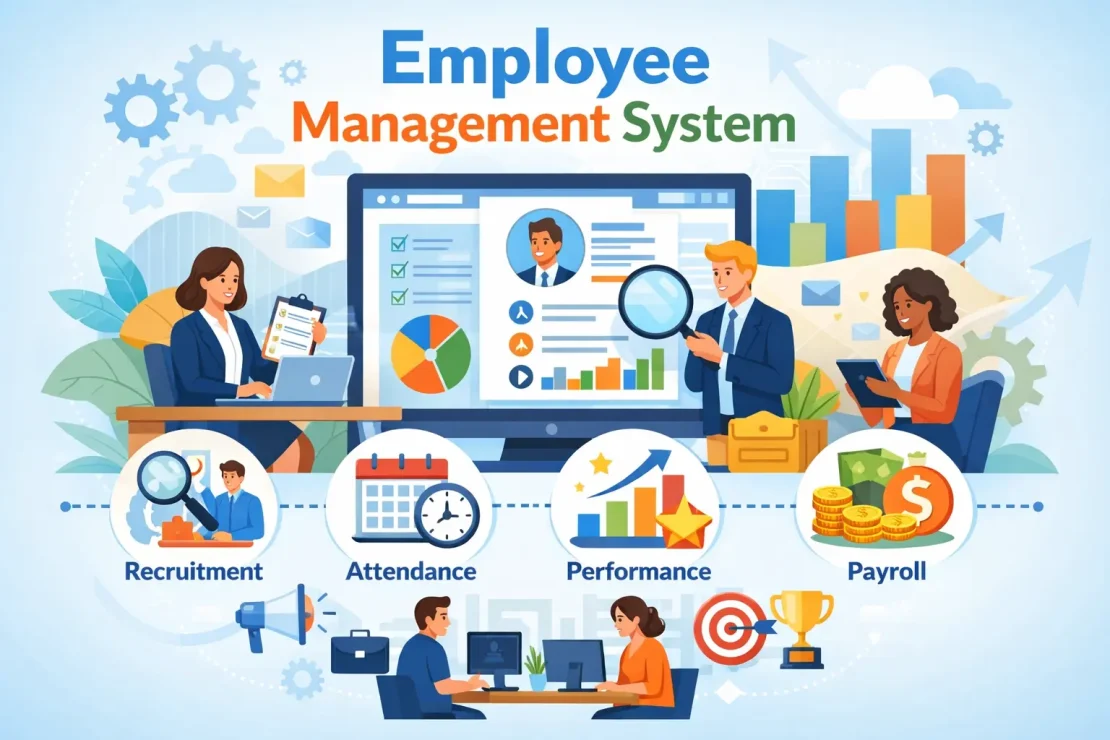
An Employee Management System is an online tool that will be used to automate and handle the main HR processes concerning staff. It allows the storage of employee information, attendance, payroll, performance management and other various daily HR functions to run off of one centralized system.
The Fit of EMS within the HR and Business Operations:
The EMS serves as the support of the HR functions. It integrates employee information into attendance, payroll, compliance, and reporting to enable HR departments and management to make quick decisions. In case of expanding organizations, this integration is necessary to keep the organization efficient.
EMS vs HRMS vs HR Software:
Although the two terms are used interchangeably, there exist differences:
Employee Management System is mainly centered on employee data, attendance, payroll and performance.
- Human resource management System (HRMS) consists of EMS functions as well as high-level workforce planning and talent management.
HR management software is a more generalized term that can comprise of recruitment, onboarding, and learning modules.
Simple Example:
Rather than filling out attendance sheets by hand and adding the information to the payroll software, an EMS automatically records the working hours, uses salary regulations, and provides pay slips with the correct deductions.
The most important characteristics of an Employee Management System are:
- Employee Records & Database:
Any Employee Management software is built on the basis of a centralized employee database. It stores:
- Personal information
- Position description and specifics of the department.
- Documents and employment contracts.
Educational records and professional records.
This does away with paperwork and guarantees real-time availability of the correct employee data.
- Attendance management:
This module handles attendance and leave request.
Having an HR attendance software integrated, the businesses can:
- Monitor overtime and working hours.
- Organize leave requests and approvals.
- Automatically contemplate attendance data in payroll.
This minimizes the use of manual error and equitable compensation.
- Payroll Management:
In the HR functions, payroll is among the most sensitive tasks. An EMS ensures:
- Proper salary computations.
- Automated tax deductions
- Creation of payslips and payment of salaries.
Payroll modules used by business in Pakistan can be used to compute tax on salary in Pakistan through built-in business logic or even built-in logic built in as salary tax calculator Pakistan to ensure business compliance.
- Performance Management:
An EMS facilitates formal performance reviews through facilitating:
- KPI tracking
- Appraisals and evaluations
- Goal setting and feedback
This assists in aligning the performance of employees with the business goals.
- Employee Self-Service Portal:
A self service portal enables employees to:
- View payslips
- Apply for leave
- Revise personal details.
This minimizes the HR workload and enhances transparency.
- Reporting & Analytics:
State-of-the-art reporting tools give insights into:
- Attendance trends
- Employee turnover
- Workforce productivity
Evidence-driven knowledge assists the management to strategize.
The advantages of an Employee Management System:
Conserves Time and Minimizes Error:
Repetitive work such as manual attendance record keeping and payroll calculations are eradicated through automation and human errors are highly minimized.
Improves Employees Experience:
Self-service and open process make the employees feel engaged and informed.
Enhances Reporting and Compliance:
Automated documentation and audit-ready reports guarantee that the labor laws, tax laws and internal policies are met within an EMS.
Favors Improved Decision-Making:
Live reports and analytics will enable HR leaders to make prudent decisions when it comes to hiring, performance and planning the workforce.
The Question of Selecting the appropriate Employee Management System:
The choice of the EMS is significant to success in the long term.
Key Factors to Consider:
- This is due to the size and complexity of the workforce of the company.
- Budget and scalability
- Features and integrations that are required.
Cloud-Based vs On-Premise EMS:
Cloud based EMS is flexible, can be accessed remotely and the costs of installations are lower.
On-premise EMS is more controllable but expensive to maintain.
Ease of use and Maintenance:
The interface is intuitive and supported with a lot of reliability to achieve quicker adoption and easy operation.
Problems and the Solutions of EMS to Them:
Paperwork and manual processes:
EMS automates operations and removes paper files and manual input.
Data Inaccuracy:
Data bases are centralized, which makes data on employees consistent and accurate.
Late Payroll/ Approvals:
Payrolls and leaves are processed faster through automated workflows.
Absence of a Centralized Reporting:
EMS has integrated dashboards and reports to enhance visibility.
Trends in Employee Management Systems in the Future:
AI and Automation in HR:
EMS solutions based on AI will forecast the trends in the workforce and automate routine HR decisions.
Mobile and Remote Workforce Management:
Remote teams will be supported by mobile-friendly platforms that will allow them to access HR services in real time.
Data-Intensive Human Resource Decision-Making:
More sophisticated analytics will be used in talent and strategy management.
Conclusion:
Employee Management System is not a luxury but a necessity that is present in contemporary businesses. The hr onboarding software solutions change the way organizations handle their workforce by automating Hr processes, making them more accurate, and increasing the experience of their employees.
The operational efficiency of businesses, compliance assurance, and data-driven insights that can contribute to sustainable growth are enjoyed by the businesses that use the platforms of modern human resource management systems.